

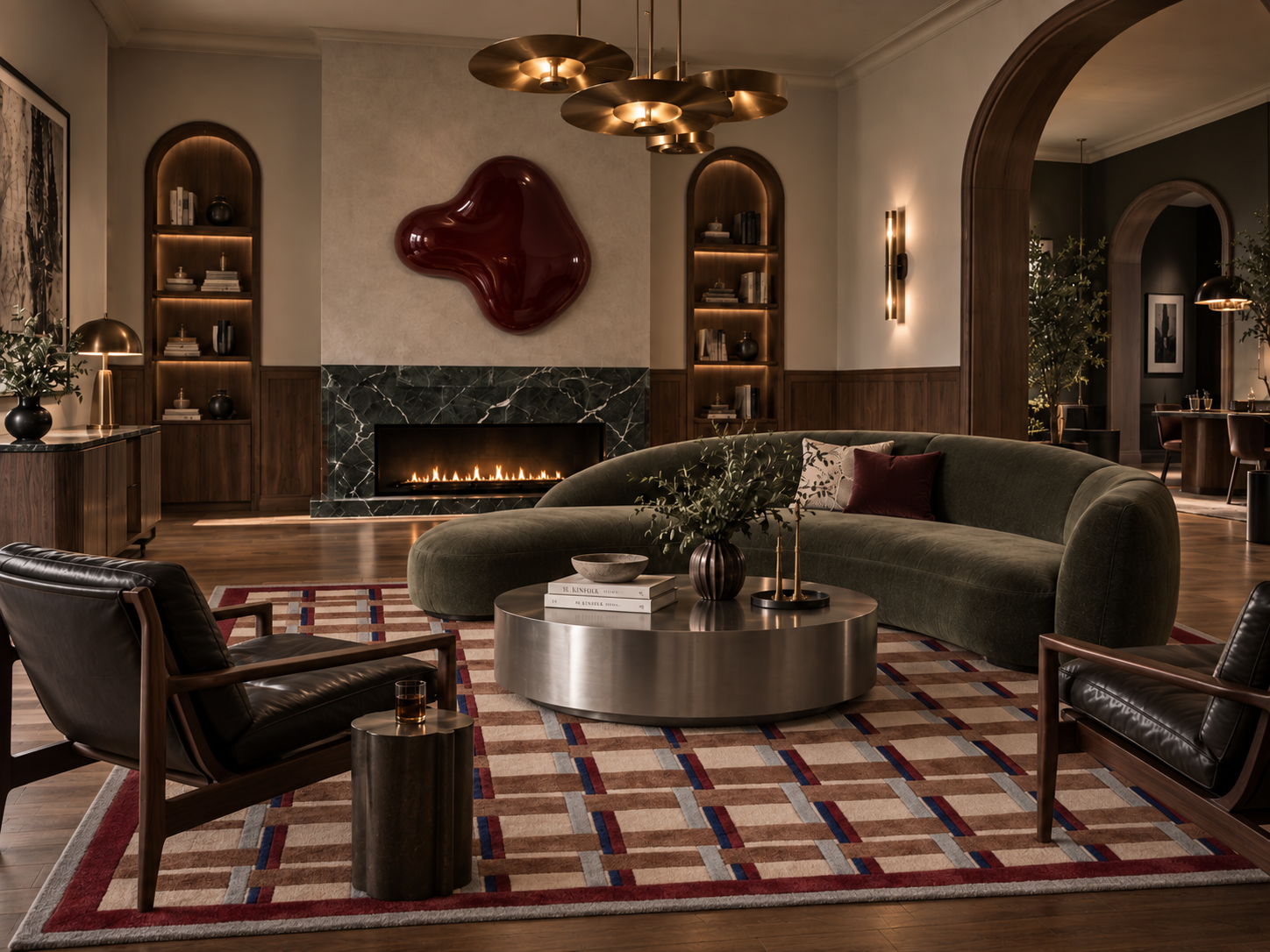
Walk into the right kind of room and you can feel it before you can name it. A curved sofa sits against a strong architectural line. Brass catches the low evening light. Rich timber grounds the space while sculptural lighting creates a sense of glamour that never tips into excess.
There is a growing desire for interiors that feel like this. After years of quiet minimalism and neutral palettes, contemporary design is moving towards spaces with greater depth, personality and atmosphere. At the centre of that shift is Neo Deco.
Rooted in the Art Deco movement of the 1920s and 1930s, Neo Deco takes the geometry, craftsmanship and material richness of the period and translates them for contemporary life. It is not an attempt to recreate the past. Instead, it takes the elements that made Art Deco enduring and removes what no longer feels relevant.
The result is more restrained, more tactile and considerably more personal.
A More Considered Kind of Luxury
Classic Art Deco was unapologetically decorative. Its interiors embraced symmetry, ornament and theatrical displays of wealth. Neo Deco approaches luxury differently. It is less concerned with making every surface remarkable and more interested in creating a considered relationship between the elements within a space.
This reflects a broader change in contemporary interiors. Luxury is increasingly being defined by quality and individuality rather than excess. A beautifully executed piece of joinery can have more impact than a room filled with decoration. A single stone surface can become the focal point when its materiality is given enough space to speak.
Geometry With a Softer Edge
Geometry remains one of Neo Deco's strongest connections to its origins. Strong architectural lines establish structure while curves introduce softness and movement. Arched openings, fluted surfaces and carefully considered symmetry reference the Deco era without becoming historical reproductions.
The relationship between these forms is what gives the style its contemporary character.
A sculptural curved sofa can soften an architectural interior. A geometric console can provide structure beneath an organic artwork. These contrasts prevent the room from becoming too rigid and create an interior that feels collected rather than prescribed.
Proportion becomes more important than ornament. The architecture establishes the rhythm, while furniture and detailing respond to it.
Materiality Over Decoration
Neo Deco's richness comes increasingly from materials rather than embellishment.
Dark walnut and other richly toned timbers bring warmth and depth to interiors that have spent years favouring lighter woods. Natural stone introduces variation through its veining and texture. Brushed metals provide subtle reflection without the visual intensity of highly polished finishes.
This renewed interest in materiality reflects another significant direction in contemporary design. Interiors are becoming more tactile. The experience of a material matters as much as its appearance.
A honed stone surface beside a textured upholstery fabric creates a different sensory experience from a room where everything is smooth and reflective. Neo Deco thrives on these contrasts because they allow luxury to feel natural rather than manufactured.
Colour Becomes More Confident
Neo Deco is also part of a wider movement away from the dominance of neutral interiors.
The contemporary palette is becoming deeper and more atmospheric. Warm earthy tones, charcoal, olive, burgundy and rich green are finding their way into walls, upholstery and architectural finishes. Rather than appearing as occasional accents, colour is increasingly being used to establish the character of an entire space.
This does not mean abandoning restraint. It means becoming more confident about creating atmosphere.
A deep colour can make a room feel intimate. A tonal interior can create continuity between architecture and furniture. When used deliberately, colour becomes part of the architecture rather than something added afterwards.
This is where Neo Deco begins to move beyond a recognisable aesthetic. It becomes a way of controlling how a space feels.
Why Neo Deco Now?
Perhaps the reason Neo Deco resonates so strongly is that it responds to what contemporary interiors have been missing.
Minimalism gave us clarity. It reduced visual noise and brought attention to proportion and functionality. But as that language became increasingly widespread, interiors began to look remarkably similar. The desire for individuality has consequently become stronger.
Neo Deco offers another direction.
It allows interiors to be expressive without becoming excessive. It embraces colour without sacrificing sophistication. It introduces glamour without requiring formality. Most importantly, it creates room for personality.
This makes it particularly relevant to luxury residential and hospitality design, where the experience of a space matters as much as its appearance. A home should feel personal to the people living in it. A hotel or restaurant should communicate its own identity rather than conforming to a predetermined idea of luxury.
Designing Beyond the Trend Cycle
Neo Deco may have emerged as a response to the current appetite for richer and more expressive interiors, but its appeal extends beyond the immediate trend cycle.
Its emphasis on proportion, craftsmanship, materiality and individuality gives it a stronger foundation than a purely decorative trend. These are qualities that can remain relevant long after particular colours or furniture shapes have changed.
Perhaps that is ultimately what makes Neo Deco so compelling.
It is not really about bringing Art Deco back.
It is about bringing character back into contemporary interiors. It is a celebration of richness without excess, glamour without pretension and craftsmanship without unnecessary decoration. In a design landscape searching for greater individuality, Neo Deco offers a way forward that feels both familiar and entirely of its time.